 EN
EN

 Pronósticos NFL
  Pronósticos MLB
  Pronósticos NBA
  Pronósticos NHL
  Pronósticos de Fútbol
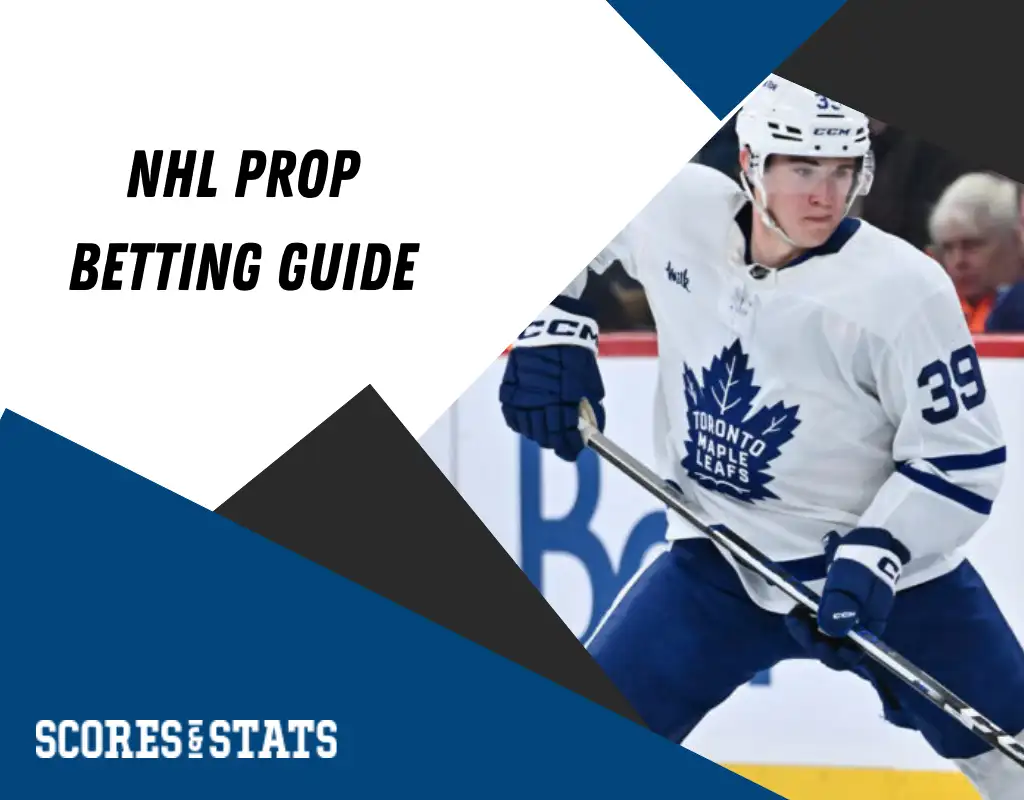
An NHL prop is a bet on something inside a game or a season other than who wins: a player’s goals, points or shots, a team’s power-play goals, or a season award such as the Hart Trophy. The 2026-27 regular season opens on Tuesday, September 29, with Florida at Carolina, so player props return for every game from that night.
This guide covers the main types of NHL props, how to price them, and how to research them from public stats.
Types of NHL props
Player props are about one player’s numbers, and whether his team wins has no bearing on them. The common ones:
- Goals: will he score, or over/under 0.5 goals.
- Points: goals plus assists, usually over/under 0.5 or 1.5.
- Shots on goal: over/under a line such as 2.5 or 3.5.
- Assists, first goal scorer and last goal scorer.
- Saves: for goaltenders, over/under a number such as 27.5.
Team props follow one team: its total goals, power-play goals, penalty minutes or shots on goal. Game props take both teams together: the total, the winning margin, whether there is an empty-net goal, or which team reaches a number of goals first.
Season props run to the end of the year: the Stanley Cup winner, division winners, playoff appearances, team point totals and the awards. The Hart Trophy goes to the league’s most valuable player, the Rocket Richard Trophy to the top goal scorer, the Vezina to the best goaltender, the Calder to the best rookie and the Norris to the best defenseman.
How to read a prop price
Every price is a probability. At -150 a bet needs to win 60.0% of the time to break even, and at +250 it needs 28.6%. A prop is worth betting only when you rate the chance higher than the price does.
Take the one season award market posted so far for 2026-27. DraftKings, through ESPN, has Connor McDavid at +300 for the Hart Trophy, which implies 25.0%, and Nathan MacKinnon at +350, which implies 22.2%. Nikita Kucherov, who won the award for 2025-26, is +1200, or 7.7%. Add up all 82 prices in that market and the implied chances come to 173.4%: the 73.4 points above 100 is the book’s margin, and it is why season props need a bigger edge than a single-game bet.
How to research an NHL prop
Start with the full-season numbers on ESPN’s NHL stats or the NHL’s own stats site. McDavid finished the 2025-26 regular season with 48 goals, 90 assists and 138 points in 82 games, according to ESPN. That is 1.68 points a game, which tells you why his points line is usually set at 1.5 and not 0.5.
Then go to the game log. Season averages hide streaks, injuries and changes of linemate, and a player’s last ten games often say more about tonight’s shots line than his season does. Check who is in goal for the other team, since a backup goaltender changes the price of every scoring prop in the game.
Shop the same prop across books. Prices on props vary more than on the moneyline, because each book sets them with less money behind them. A goal scorer at +180 in one book and +210 in another is the difference between needing 35.7% and 32.3%.
Tips for betting NHL props
Keep emotion out of it. The easiest way is not to bet props on your own team, where you will read every stat in its favor.
Set a budget for the season, then a size for each bet, and hold both. Props are high-variance: a first goal scorer at +900 needs to win only 10.0% of the time, so you can lose many in a row while pricing them correctly.
Keep a record. Write down every prop with its type, price, stake and result. After a few hundred bets you will see which kinds you price well and which you do not, and that is worth more than any single pick.
Watch for late news. A scratch announced at the morning skate moves every prop on that player and several on his linemates, and books do not all move at the same speed.
The Stanley Cup Final and the playoffs
The playoffs bring their own props: series length, whether a series goes to overtime, and a Conn Smythe Trophy market for the most valuable player of the postseason. Carolina won the 2026 Stanley Cup, beating Vegas four games to two and clinching with a 3-0 win in Game 6 on June 14. The 2026-27 regular season runs to April, and the next postseason starts in April 2027.
Our game-by-game reads are on the NHL predictions hub. For paid NHL picks, see the top handicappers.

