 ES
ES

 NFL Previews
  MLB Previews
  NBA Previews
  NHL Previews
  Soccer Previews
Match Facts
| Item | Detail |
|---|---|
| Game | Montreal Canadiens at Pittsburgh Penguins |
| Venue | PPG Paints Arena, Pittsburgh |
| Schedule spot | Both teams coming off deflating home losses on Tuesday |
| Penguins record note | Struggling in extra time (1-7 in games beyond regulation, 0-5 in shootouts) |
| Canadiens record note | 5-8-1 in their last 14, five losses by 4+ goals |
| Key storyline | Penguins blew a late lead and gave up a short-handed equalizer with 0.1 seconds left; Canadiens trying to stabilize after another lopsided defeat |
| Playoff context | Both chasing relevance in the Eastern race, with Pittsburgh under more immediate pressure to convert close games into points |
For a broader statistical snapshot and roster overview, you can cross-reference both clubs on the main NHL teams hub via the NHL teams page, and compare how this matchup is priced on the live NHL scores and odds board.
Line and Odds
- Moneyline: Penguins favored at home, Canadiens priced as road underdogs in the +160 range
- Puck line: Penguins -1.5 at plus money; Canadiens +1.5 juiced for those expecting another tight game
- Total: 6.5 goals, shaded slightly toward the over on early action
Movement Matchup
This is less about dramatic odds movement and more about how bettors react to two very different types of bad losses. Pittsburgh just suffered a true gut punch: up a goal, on the power play, and somehow giving up a short-handed equalizer with a tenth of a second left before losing in a shootout. That result reinforces an existing concern: the Penguins are now 1-7 in games that go beyond regulation and 0-5 in shootouts. The market generally does not overreact to shootout variance, but it does punish teams that repeatedly fail to close.
Montreal’s problem profile is different. The Canadiens are 5-8-1 in their past 14, with five of those losses coming by four or more goals. That suggests systemic issues rather than a few bad breaks. Early blowups, like the three first-period goals they allowed to Tampa Bay on Tuesday, make them a hard team to trust on the road unless the price is extreme.
With Evgeni Malkin out week-to-week, the Penguins lose a major creator and power-play presence, but they still have the best singular force in this matchup in Sidney Crosby. Montreal is calling up help from Laval, which can inject energy but also raises questions about chemistry and mistake risk in a hostile building. From a pricing standpoint, that usually pushes money slightly toward the more stable, veteran core at home.
If you are tracking the bigger-picture context for each club within their divisions, this matchup sits against a futures backdrop where the Penguins are part of a crowded Metropolitan race frequently analyzed in Metropolitan Division odds breakdowns, while the Canadiens are trying to punch above their weight in a deep Atlantic field covered in Atlantic Division odds previews.

Follow Winning Trends Across Every League
The Smartest Way to Bet Daily
Breakdown Injury Reports
Pittsburgh Penguins injury report
| Player | Status | Note |
|---|---|---|
| Evgeni Malkin (F) | Out, injured reserve | Upper-body injury, week-to-week; major loss for top-six scoring and power play |
| Other regulars | Day-to-day / minor knocks | No new long-term issues specified, but depth forwards may see role bumps in Malkin’s absence |
| Goaltending | Active | Jarry carrying the load; shootout struggles are performance-based, not health-based |
Montreal Canadiens injury report
| Player | Status | Note |
|---|---|---|
| Jacob Fowler (G) | Recalled | Up from AHL Laval; could back up or push for a look if struggles continue |
| Adam Engstrom (D) | Recalled | Depth reinforcement; could rotate into third pair or sheltered minutes |
| Owen Beck (F) | Recalled | Fresh body for a forward group that has struggled defensively and in transition |
| Other regulars | Active | No new long-term injuries specified beyond ongoing depth and performance concerns |
Pittsburgh Penguins Recent Performance
Pittsburgh’s season has become a series of almosts. The loss to Anaheim was the latest chapter: they held a one-goal lead, were on a power play with under 20 seconds left, and still found a way to let it slip. The broader pattern is just as concerning. The Penguins are competitive in most games, but they have repeatedly failed to convert that into wins once regulation ends, stumbling to a 1-7 record in extra time.
At five-on-five, the Penguins still do enough to justify being a favorite at home against a team like Montreal. Their structure is generally sound, and their top-end talent can tilt shifts in their favor. The issue is focus and execution in key moments, whether that is a casual entry on a late power play or a poor choice in overtime. With Malkin out, even more burden falls on Crosby and the top line to drive offense and set the tone.
The coaching staff has openly acknowledged that the shootout lineup and approach will be evaluated, but that does not fix the core problem of game management late in regulation. If Pittsburgh can clean that up, the underlying metrics suggest a team that should bank points in matchups like this and slowly climb back into relevance in the Eastern landscape that is also examined in conference futures breakdowns.
Montreal Canadiens Recent Performance
Montreal’s issues are less about late-game execution and more about the full 60 minutes. Falling behind 3-0 in the first period against Tampa Bay is part of a trend that has frustrated both the staff and the core players. They have been out of too many games early, and when they do push back, it is often from a hole that is already too deep.
Cole Caufield’s frustration is telling. When he talks about needing to be more mature and not letting games get out of hand, he is highlighting breakdowns in coverage, weak help defense, and lapses in detail that show up all over the film. The Canadiens have made a habit of being out of structure, especially against sharper, more experienced teams.
The call-ups from Laval – Fowler, Engstrom, Beck – are a clear signal that the organization is willing to shake things up. Fresh legs and internal competition can stabilize certain spots, but they also introduce volatility, especially on the road in a building where the home side is desperate for a rebound. Montreal’s recent string of lopsided losses makes them a team you want a strong price to back, particularly against veteran cores that punish mistakes.
Betting Insights and Trends
From a betting perspective, this matchup comes down to whether you trust Pittsburgh to respond professionally after a brutal collapse, or whether you think the emotional hangover will linger long enough for a hungry underdog to take advantage. The Penguins’ five-on-five play and home-ice edge position them as the more logical side, even without Malkin. Their repeated failures in overtime and shootouts, though, are a real concern if you are laying a heavy moneyline price or counting on them to win tight coin-flip games.
Montreal’s variance is higher, but not the good kind. Their pattern of multi-goal losses and early blowouts suggests there is real downside when they face structured, veteran teams on the road. To justify backing the Canadiens, you are betting on them tightening up defensively and translating that into a full, disciplined 60-minute effort. That is possible, but their recent film and results make it more speculative than Pittsburgh’s path to a routine home win.
Totals will hinge on which version of each team shows up. If Pittsburgh plays a cleaner, more controlled game and Montreal avoids another early meltdown, a 3-2 or 4-2 type result fits the profile. However, if the Canadiens’ defensive lapses continue and the Penguins finally cash in on their chances, this could tilt toward a higher-scoring script that threatens the over late.
Streamline Your Picks in One Dashboard
All Sports. All Experts. One Login.
Best Bets and Prediction
Projected score: Penguins 4, Canadiens 2
In the most likely scenario, Pittsburgh channels the embarrassment of the Ducks loss into a sharper, more businesslike effort at home. Even without Malkin, they have enough top-end skill and structure to exploit Montreal’s defensive inconsistencies and early-period lapses. The Canadiens can generate chances and have enough offensive talent to avoid being completely shut down, but their tendency to let games get away makes a full upset less appealing than the price might suggest.
The clearest angle aligns with a Penguins-focused position, especially in regulation, where you remove their shootout issues from the equation. Given Montreal’s recent history of multi-goal losses and Pittsburgh’s need to assert control, the projected 4-2 score leans toward a comfortable home win rather than another coin-flip decided in extra time.
Handicapper section
From a handicapper’s standpoint, this game sits firmly in the “process versus variance” bucket. Pittsburgh’s underlying play and five-on-five structure are not those of a fragile team; the record in overtime and shootouts is more about small-sample execution and mental lapses than fundamental weakness. Against a Canadiens side that has been exposed repeatedly by sharper opposition, the Penguins profile as the more sustainable, trustworthy option in a standard home spot.
Montreal’s path to value is narrower. You are effectively betting on a hard reset in habits and detail, plus the idea that the call-ups from Laval will lift both energy and accountability without adding too many mistakes. That is not impossible, but it is a thinner edge than backing a veteran Penguins core in a clear bounce-back spot. In a broader futures context, this is the kind of game that matters far more to Pittsburgh’s trajectory in markets like Stanley Cup or Eastern Conference outrights discussed in Stanley Cup odds previews than it does for Montreal, which is still more in developmental mode than true contention.
In practical terms, this matchup shapes up as Penguins in regulation as the sharper angle, with full-game moneyline still workable for parlays or risk-averse builds. Any play on Montreal is a contrarian swing that relies heavily on a sudden, sustained improvement in discipline and defensive execution that they have not shown often enough in recent weeks.
Navy Midshipmen vs Army Black Knights Game Preview
The Navy Midshipmen and Army Black Knights meet once again in one of college football’s most storied rivalries. Played annually in December as the final game of the regular season, this clash is about more than just records—it’s about tradition, pride, and discipline. Both service academies bring similar schemes and mentalities to the field, often producing a low-scoring, physical battle that’s dictated by execution and field position.
Army and Navy each run variations of the triple-option offense and prioritize possession control, making this one of the slowest-paced games on the NCAAF calendar. That historically results in a total far below most matchups, and sharp bettors know to approach this rivalry with a different lens.
To stay ahead of oddsmaker adjustments, compare this year’s line movements on the NCAAF odds and scores page for sharper totals insights.
Access the Top Sports Picks in Real Time
Never Miss a Winning Edge Again
Odds and Key Information
Army opened as a slight favorite, laying around 2.5 points in most books. The total, as expected, is extremely low—hovering near 28, which continues a recent trend of historically low over/unders in this rivalry. This is largely due to both teams ranking near the bottom of the FBS in plays per game and pass attempts.
Given the limited possessions, each drive carries added weight. Field position, turnovers, and fourth-down decisions are often the true deciding factors. Games like this require an adjusted betting approach, as explored in our NFL expert betting guide that also applies to slow-paced, clock-dominant matchups.
Navy Midshipmen Outlook
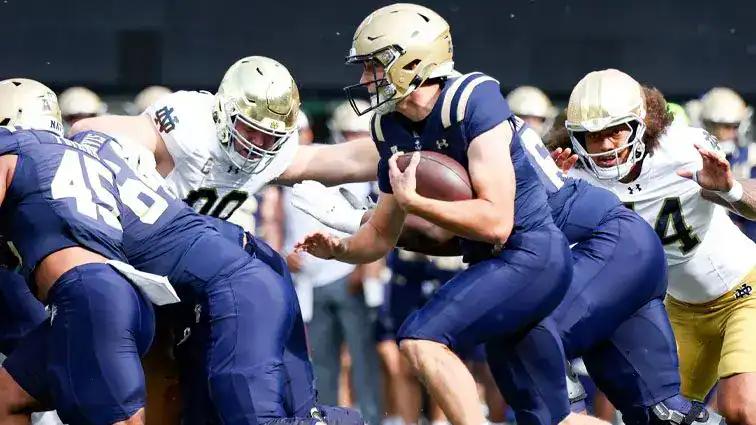
Navy enters this year’s matchup with an identity rooted in physicality and clock management. Their offense ranks among the nation’s lowest in passing volume, but they lead in time of possession and rushing attempts. They’ve struggled against faster teams this season, but against Army, their style aligns well.
On defense, Navy has been solid against the run, which is critical in this matchup. They rank top-30 nationally in rushing yards allowed per game and will likely stack the box against Army’s option looks. Their biggest challenge will be avoiding chunk plays off misdirection—an area where they’ve been vulnerable.
Navy will need long, sustained drives to keep their defense fresh. If they fall behind early, their limited passing game could become a liability.
You can review their season-long betting record, including ATS trends, on the NCAAF picks page, which tracks how well service academies perform in low-total games.
Army Black Knights Outlook
Army’s offense mirrors Navy’s in philosophy, but they’ve mixed in more shotgun formations this season. While they still run a heavy option attack, the Black Knights have shown a willingness to throw the ball more frequently on early downs to catch defenses off guard.
Defensively, Army has also been reliable against the run, making it likely that this game will be decided in the trenches and on special teams. Their ability to adjust mid-game has been a key reason for their recent rivalry success—having won five of the last seven matchups.
Army also holds a slight edge in red zone efficiency, converting more of their drives into points than Navy this season. That could be the deciding factor in a game where every field goal matters.
Check out how Army has performed historically in rivalry and low-total situations by browsing team-specific trends via the NCAAF teams database.
Betting Trends
Unders have dominated this rivalry. The last 17 meetings between Navy and Army have gone under the total—a trend nearly unmatched in college football. These games often feature fewer than 10 total possessions per team, making every mistake critical.
Against the spread, Navy has covered in four of the last six meetings. However, Army has won the last two games straight up and has been slightly more consistent overall this season.
This is a spot where line value can be razor thin, and bettors should consider approaches like 1st half unders or alternate spreads when available.
The Lean
As is often the case in Army-Navy games, the safest lean is the under—even at a historically low number. Neither team passes often, both milk the clock, and both rank top-10 in time of possession. Expect limited possessions, long drives, and a game likely decided by a single turnover or missed assignment.
On the spread, Army has shown more offensive versatility and slightly better execution in red zone scenarios. That may give them the edge in what figures to be another one-possession game.
Prediction: Army 17, Navy 13
Spread Lean: Army -2.5
Total Lean: Under 28
Compare Expert Predictions Instantly
All Angles, All Stats, One Place
Why You Need Expert Picks
Games like Army vs Navy require a different betting mindset. Traditional trends don’t apply, and edge comes from understanding tempo, execution, and situational football. That’s where expert cappers offer value, especially in rivalry and service-academy matchups where sharp angles often get buried under public narratives.
Follow proven analysts all season long on the college football leaderboard to get insight on matchups like this. And for broader betting strategy, our NFL betting guide explains how low-possession football impacts spread and total outcomes.
Bakersfield Roadrunners vs North Dakota State Bison Game Preview
The Bakersfield Roadrunners head to Fargo to face the North Dakota State Bison in a non-conference matchup featuring two teams aiming to steady their seasons early. Both programs are known for tough, physical play and methodical half-court offense, which sets up a potential grind-it-out contest.
Bakersfield is coming off a stretch of inconsistent performances, particularly on the offensive end, while North Dakota State looks to defend home court after a strong start to their campaign. With both squads trying to build identity heading into conference play, this game carries quiet importance—and betting value.
Slower tempo and controlled possessions mean this one could play tighter than the spread suggests. For sharp bettors following college basketball odds and scores, these mid-major matchups often create exploitable situations.
Streamline Your Picks in One Dashboard
All Sports. All Experts. One Login.
Odds and Key Information
North Dakota State opened as a 5.5-point home favorite, with the total hovering around 131. This line reflects the Bison’s more efficient scoring and home-court consistency, while also accounting for Bakersfield’s offensive limitations.
That low total suggests bookmakers expect a half-court-heavy game with long possessions and fewer transition opportunities—something to consider when applying under betting strategies or second-half live plays.
Bakersfield Roadrunners Outlook
The Roadrunners continue to lean on their defensive identity, but they’ve had trouble generating offense consistently. Scoring in the half court has been inefficient, and the team struggles to create high-percentage looks without turning the ball over. Their shooting splits remain among the worst in their conference, with sub-30% shooting from three.
Still, Bakersfield competes physically and often keeps games close even when they’re outmatched on paper. They’ll need to win the rebounding battle and force North Dakota State into low shot-clock possessions to have a shot on the road.
Understanding how to evaluate teams like this from a betting perspective often involves risk control methods like betting units and avoiding overreactions to recent box scores.
North Dakota State Bison Outlook
North Dakota State is off to a solid start, showing strong fundamentals on both ends of the floor. The Bison run a structured offense with a focus on high-percentage interior looks, while also playing disciplined defense without fouling. At home, they’ve been particularly consistent—winning most of their non-conference games by controlling tempo and exploiting mismatches.
What separates this Bison team from others is their ability to avoid turnovers and maintain composure in late-game situations. That’s critical in lower-possession games where each trip down the floor matters more. Their free-throw shooting has also improved this season, adding to their value in closing out spreads.
When teams like the Bison hold the tempo advantage, bettors can find value in tools like live totals betting or fading the public on inflated overs.
Betting Trends
Bakersfield is just 2-8 against the spread in its last 10 road games and trends heavily toward the under in non-conference play. Their offensive woes make it difficult to back them outright unless the total is mispriced.
North Dakota State has covered in four of its last five home games and typically performs well when favored by fewer than 7 points. The Bison also trend under in games with similarly slow-paced opponents.
These mid-major trends are easier to track with daily access to NCAAB picks and betting insights from expert handicappers.
Bet With Confidence, Not Guesswork
Data + Discipline = Results
The Lean
The Bison hold the edge here with home-court advantage, stronger offensive execution, and better late-game fundamentals. Bakersfield’s defense should keep things competitive early, but without reliable scoring, they may struggle to stay within the number in the second half.
If the line stays under 6, North Dakota State is the lean. The total projects low-scoring, especially if both teams commit to long possessions and minimal fouling.
Prediction: North Dakota State 66, Bakersfield 58
Spread Lean: North Dakota State -5.5
Total Lean: Under 131
Why You Need Expert Picks
Mid-major matchups like Bakersfield vs North Dakota State are often undervalued by public bettors—but they offer some of the best edge opportunities. Our analysts dive into matchup metrics, shooting efficiency, and tempo to deliver sharp predictions you can trust.
Track real-time performance on the college basketball picks leaderboard and sharpen your approach using strategic content like hedging methods and sportsbook betting psychology.
Match Facts
| Item | Detail |
|---|---|
| Game | Tampa Bay Lightning at New Jersey Devils |
| Venue | Prudential Center, Newark, New Jersey |
| Schedule spot | Each team coming off a decisive win that snapped a multi-game losing streak |
| Recent result – Devils | 4-3 home win vs. Senators, ending a five-game skid |
| Recent result – Lightning | 6-1 road win at Canadiens, ending a four-game skid |
| Season series | Split 1-1: Devils 5-3 win on Oct. 11; Lightning 5-1 win on Nov. 18 |
| Home/road form | Devils 9-4-1 at home; Lightning 9-4-2 on the road |
Bettors tracking the full Thursday slate can see how this matchup is priced relative to the rest of the board on the NHL scores and prices screen under the main NHL scores and odds hub, and where each club fits in the bigger league picture on the NHL teams page.
Line and Odds
- Moneyline: Devils projected as a slight home favorite with Tampa Bay a live road underdog
- Puck line: Devils -1.5 at plus money; Lightning +1.5 providing goal protection in what profiles as a one-goal game
- Total: 6.5 goals, with market respect for both offensive ceilings despite recent slumps
Movement Matchup
This number is shaped more by context and matchup than by either team’s last scoreline. New Jersey’s 4-3 win over Ottawa finally halted a five-game skid, but the way they did it matters more than the simple result. The Glass–Gritsyuk–Brown line carried play by keeping it simple: hard forecheck, pucks deep, quick support, and point shots with traffic. That is exactly what Cody Glass referenced when he talked about “simplifying” during a losing streak. For the Devils, it is a welcome counterbalance to their usual rush-heavy, high-skill game.
Tampa Bay’s reset in Montreal was similar in spirit but different in execution. Darren Raddysh’s two-goal night and Jonas Johansson’s third straight strong outing were emblematic of a team that needed contributions from beyond its headline stars. After back-to-back 2-0 shutouts, the Lightning finally broke out with six goals and a dominant road effort, reaffirming why they still show up positively in broader futures breakdowns like the league-wide Stanley Cup odds discussion.
The key tension here is sustainability. New Jersey’s fix is about structure: if they keep that simplified, north-south game layered on top of their existing skill, their underlying metrics suggest more wins are coming. Tampa Bay’s problem is health: losing Victor Hedman again after only a brief return, on top of Andrei Vasilevskiy’s absence, forces them to lean heavily on depth pieces and Johansson’s run of form. That is the kind of situation handicappers track closely in more detailed divisional looks, such as Metropolitan Division odds for the Devils and Atlantic Division odds for the Lightning.
Follow Winning Trends Across Every League
The Smartest Way to Bet Daily
Breakdown Injury Reports
New Jersey Devils injury report
| Player | Status | Note |
|---|---|---|
| Top forward core | Expected to play | Glass, Gritsyuk and Brown all active and productive in the Ottawa win |
| Defensive group | No new issues reported | Regular blue-line rotation expected based on the information provided |
| Goaltending | Projected starter | Starter not specified in the report; expect usual tandem usage with confirmation closer to puck drop |
Tampa Bay Lightning injury report
| Player | Status | Note |
|---|---|---|
| Victor Hedman (D) | Questionable / day-to-day | Left the Montreal game after the first period with an undisclosed issue; undergoing further evaluation |
| Andrei Vasilevskiy (G) | Out | Starter still sidelined; no timeline given in the report |
| Jonas Johansson (G) | Active | Four straight starts; has stopped 66 of his last 69 shots over three games |
| Depth skaters | Expected to play | No additional injuries noted in the supplied information |
The Hedman situation is the swing piece. If he cannot go, Tampa’s blue line loses its anchor, and the market will adjust toward New Jersey, something that is often unpacked in match-specific writeups inside the NHL expert betting guide.
New Jersey Devils Recent Performance
On paper, a five-game losing streak looks ugly; on the ice, New Jersey’s issues have been more about execution and game management than complete structural collapse. The Ottawa win showed what a reset can look like. The Glass–Gritsyuk–Brown line drove a simple, repeatable game: win races, get pucks low, feed the points, create chaos. Eight combined points for that unit is proof of concept.
Brown and Gritsyuk already burned Tampa Bay earlier in the season, combining for four points in the Devils’ 5-3 win, which matters when projecting how New Jersey’s depth can match up against a Lightning team potentially missing Hedman again. If the Devils can keep the same “clear mind” Glass talked about and avoid the risky east-west plays that have bitten them, their underlying chance generation should translate into more consistent scoring.
From a handicapping angle, that profile is why New Jersey still shows up as a buy-low candidate in more forward-looking content, including conference-level futures like Eastern Conference odds.
Tampa Bay Lightning Recent Performance
Tampa Bay’s recent run has been a roller coaster. Back-to-back 2-0 shutout losses underscored how fragile the offense can look when the power play goes quiet and the middle six fails to finish. The 6-1 response in Montreal was exactly the kind of “statement” win they needed on a road trip, with Raddysh stepping up offensively and Johansson quietly putting together a three-game stretch where he has looked like a legitimate short-term answer in net.
The problem is that the Lightning’s margin for error is shrinking. Without Vasilevskiy, they were already leaning on Johansson to outperform expectations. If Hedman is limited or out, the defensive structure takes another hit. Tampa Bay still have the top-end talent to trade chances and win a high-event game, which is why they remain a threat in longer-range Atlantic-focused outlooks such as NHL Atlantic Division odds, but in isolated road spots like this, you are asking depth players and a hot goalie to shoulder a lot of weight.
Betting Insights and Trends
This matchup sets up as a classic “who do you trust more to sustain the reset” spot. The Devils finally snapped their losing streak by simplifying and leaning on a depth line that played the right way. The Lightning snapped theirs by erupting offensively and riding another strong Johansson outing, but they may have lost their most important skater in the process if Hedman cannot go.
New Jersey’s 9-4-1 home record is not an accident. When they roll all four lines and stay on top of the puck, their pace and skill can overwhelm opponents, particularly teams that are in the middle of a long road swing. Tampa Bay’s 9-4-2 road mark is equally impressive, but the underlying story is different this season: they are grinding out results through experience and opportunism more than overwhelming shot share, which is why their volatility shows up clearly when you zoom out to full-season metrics on the main NHL teams page.
The total at 6.5 reflects two offenses that, when right, can put up crooked numbers. New Jersey’s power play and rush game can turn any night into a track meet, and Tampa Bay still have enough firepower to hold up their end. The key is whether both coaches double down on the simpler, defense-first approach that finally snapped their skids or revert to higher-risk hockey once the game opens up.
Best Bets and Prediction
Projected score: Devils 4, Lightning 3
The most likely script has New Jersey leveraging home ice, last change and their renewed commitment to a straightforward, forecheck-driven game to tilt the ice over 60 minutes. If the Devils can replicate the Glass–Gritsyuk–Brown line’s template and get even an average performance from their goaltending, they have a slight edge against a Lightning team that is still patching holes on the back end and leaning heavily on Johansson’s current form.
Tampa Bay remain absolutely capable of stealing this with their power play and transition game, especially if New Jersey fall back into old habits and feed turnovers into counterattacks. But with Hedman’s status in doubt and Vasilevskiy still out, you are asking a shorthanded blue line to withstand a Devils offense that finally looks like it has remembered how to grind out goals rather than wait for highlight-reel plays.
The cleaner side is Devils on the moneyline. The projected score leans to the over 6.5, but the strongest edge sits with the home team in a fast, high-event environment where depth, matchup control and renewed structure should matter.
Streamline Your Picks in One Dashboard
All Sports. All Experts. One Login.
Handicapper section
For handicappers, this is a textbook example of two different kinds of bounce-back spots. New Jersey’s win looks more sustainable: it came from structural adjustments, simplified execution and depth stepping up in exactly the way you want to see after a losing streak. That is the type of change that tends to hold up over multiple games and is the reason the Devils continue to be a popular candidate in more nuanced strategy pieces like the NHL betting guide and even broader divisional outlooks such as Metropolitan Division odds breakdowns.
Tampa Bay’s response in Montreal was impressive, but it is also fragile. When a team’s bounce-back is built on a blowout scoreline, a depth defenseman’s offensive spike and a goaltender on a heater, you need to treat it with more skepticism, especially when the injury report is trending in the wrong direction. The Lightning are still a team you want in your long-term portfolio in the right futures markets, including some tiers of Stanley Cup odds, but in single-game handicapping, you need to be more selective about when you pay a premium for their name recognition.
In this spot, the sharper long-run approach is to side with the Devils at home, accept that Tampa Bay’s talent always makes an upset possible and size your position accordingly. You are backing the team whose recent turnaround is driven by process and structure rather than by a one-night scoring binge that might be harder to replicate on short rest with key pieces banged up.
Match Facts
| Item | Detail |
|---|---|
| Game | Anaheim Ducks at New York Islanders |
| Venue | UBS Arena, Elmont, New York |
| Schedule spot | Both teams coming off shootout wins on Tuesday; Islanders at home, Ducks continuing strong start |
| Recent form – Islanders | Four wins in last five; three recent wins vs Tampa Bay/Colorado plus comeback vs Vegas |
| Recent form – Ducks | Four wins in last five; 8-1 in OT/SO games, multiple comeback victories |
| Division standing | Islanders third in Metropolitan; Ducks leading the Pacific by a small margin |
| Season narrative | Both clubs bouncing back from disappointing seasons under revamped front offices and coaching staffs |
For a full look at how both clubs stack up across the league, you can dig into their profiles on the NHL teams hub under the main NHL teams page, and see how this matchup compares price-wise on the live NHL scores and odds board.
Line and Odds
- Moneyline: Islanders favored at home, Ducks priced as a short road underdog
- Puck line: Islanders -1.5 at plus money; Ducks +1.5 shaded as the “safer” side in a projected one-goal game
- Total: 6.0 goals, with shading toward the over given both teams’ recent scoring form and OT/shootout profiles
Movement Matchup
This is a market adjustment game more than a typical “buy low/sell high” spot. The Islanders and Ducks have both been upgraded by oddsmakers after proving their early results are not just a one-week heater.
New York’s profile is built on structure. With Mathieu Darche reshaping the roster and Patrick Roy doubling down on details, the Islanders have quietly stacked wins against legitimate contenders: three victories over Tampa Bay and Colorado in a five-day window, then a resilient shootout win over Vegas where they dug out of a 2-0 hole. The emergence of rookie Matthew Schaefer and pick-up Emil Heineman gives them scoring and energy beyond the usual core, exactly the kind of depth that shows up as a positive in longer-range Metropolitan Division breakdowns like the Metropolitan Division odds outlook.
Anaheim’s move up the board is driven by volatility in a good way. Joel Quenneville has them playing fast, aggressive hockey with enough structure to survive mistakes. Beckett Sennecke has broken out as the first rookie to reach 25 points, and Chris Kreider’s presence on the wing gives them a proven finisher in tight games. The Ducks have trailed in 10 of their 19 wins and are 8-1 in games decided in overtime or a shootout, which is why they’ve become a regular talking point in Pacific-focused futures pieces like the Pacific Division odds breakdown.
Because both are trending up at the same time, the market is forced to pick which form is more sustainable: the Islanders’ defense-first structure and home-ice edge, or the Ducks’ comeback-heavy, late-game magic. That tension is what keeps this line relatively tight despite UBS Arena being one of the tougher buildings for visitors when New York is rolling.
Follow Winning Trends Across Every League
The Smartest Way to Bet Daily
Breakdown Injury Reports
New York Islanders injury report
| Player | Status | Note |
|---|---|---|
| Jonathan Drouin (F) | Out / day-to-day | Lower-body injury; has missed four straight games but remains an important middle-six playmaker |
| Matthew Schaefer (D) | Active | No injury issues noted; thriving in big minutes for a rookie |
| Emil Heineman (F) | Active | Healthy and contributing in the middle six; scored the lone shootout goal vs Golden Knights |
| Goaltending | Expected regular tandem | No new injury news reported; usual starter expected for a key home spot |
Anaheim Ducks injury report
| Player | Status | Note |
|---|---|---|
| Beckett Sennecke (F) | Active | Rookie sensation; first NHL rookie to hit 25 points, scored the last-second equalizer in Pittsburgh |
| Chris Kreider (F) | Active | Veteran addition has stayed healthy and is providing secondary scoring and leadership |
| Leo Carlsson (F) | Active | Delivered the shootout winner vs Penguins; usage continues to rise in key situations |
| Goaltending | Regular rotation | No specific injuries noted in the report; standard rotation expected unless late news breaks |
Given how both rosters are largely intact outside of Drouin’s absence, deeper matchup angles will lean heavily on systems and form, the kind of nuance that gets unpacked more thoroughly in the NHL expert betting guide.
New York Islanders Recent Performance
The Islanders’ current run is built on an identity that finally matches their roster. They’ve strung together wins over Tampa Bay and Colorado by sticking to a disciplined defensive shell, limiting inside looks and forcing elite offenses to the outside. That same template allowed them to weather an early 2-0 deficit vs Vegas and slowly drag the game back to their preferred pace before winning in a shootout.
Matthew Schaefer’s impact cannot be overstated. As a rookie defenseman, he is already driving play in both directions, adding a modern puck-moving element without sacrificing the physical and positional game Roy demands. Heineman’s arrival gives them another shooter and forechecker who can tilt individual shifts. Even without Drouin, New York suddenly have multiple lines that can win shifts territorially rather than just surviving.
At home, that style travels even better: last change lets Roy hunt matchups for Schaefer, and the Islanders can deploy their checking units to smother opposing top lines. That is why they are slowly easing into the conversation in Eastern-focused futures talk and long-view content like conference odds breakdowns, even if they’re not yet in the inner circle of favorites.
Anaheim Ducks Recent Performance
Anaheim’s recent stretch has been about refusing to die in games that used to bury them. They’ve trailed in more than half of their wins this season and still managed to climb back, and Tuesday’s last-second equalizer from Sennecke followed by a shootout victory in Pittsburgh is the perfect snapshot. Quenneville has given them structure, but he has not strangled their creativity; they still play with enough freedom to generate big plays when chasing a game.
Sennecke’s breakout as the first rookie to reach 25 points has given the Ducks a legitimate star-in-the-making. His size, hands and “slippery” game force defenders to respect both shot and pass, and that opens lanes for line-mates. Kreider’s arrival from the Rangers added a net-front presence and big-moment scorer who is used to playing in high-leverage games in tough buildings, something Anaheim lacked in previous years. Leo Carlsson’s shootout winner in Pittsburgh is another sign that young pieces are comfortable in pressure spots.
The concern, from a betting standpoint, is that relying on comebacks and OT/SO success is inherently volatile. Being 8-1 in extra-time games is a weapon, but it is not the kind of edge you can bank on every night. That is why, in broader championship conversations like the league-wide Stanley Cup odds picture, Anaheim still sits a tier or two below the truly elite despite their hot start.
Betting Insights and Trends
Stylistically, this is a clash between a team that wants to control the game early and one that is remarkably comfortable chasing it. The Islanders have tightened up defensively and are confident that if they stick to their structure, the chances and wins will come over 60 minutes. They have already shown they can handle elite transition teams, which matters against a Ducks group that loves to turn loose pucks into rush opportunities.
Anaheim’s resilience and OT/SO record mean that they are never out of a game, but that profile tends to be more attractive at home or in big plus-money spots where you’re betting on chaos. On the road in a building where the Islanders are feeling increasingly comfortable, you need to decide whether the comeback magic and shootout proficiency can hold up against a team that rarely beats itself when locked in.
Totals are tricky here. New York’s structural improvements suggest the under is live, but both offenses have enough pop – and enough talent on the power play – to push the game into a 4-3 type script if penalties and odd-man rushes show up. That is the kind of nuance that handicappers will weigh alongside the rest of the Thursday board and the deeper analytical insights pulled into the broader NHL betting guide.
Streamline Your Picks in One Dashboard
All Sports. All Experts. One Login.
Best Bets and Prediction
Projected score: Islanders 3, Ducks 2
The most likely script has the Islanders using home ice and matchup control to blunt Anaheim’s speed and rush game, forcing the Ducks to work through layers in the offensive zone. New York’s structure and recent habit of handling top-tier opponents make them slightly more trustworthy over 60 minutes than a Ducks team that has leaned heavily on late-game drama and extra-time success.
Anaheim still has a clear path to making this interesting: if they can get the first goal and drag the Islanders into a higher-tempo, trade-chances environment, their young skill and hot OT/SO profile come into play again. But in a straight handicap, New York’s combination of system, form and home-ice advantage gives them the edge.
For pure side value, the lean is Islanders on the moneyline, with the puck line more of a secondary angle if you think Anaheim’s comeback reservoir is finally due for some regression. The projected 3-2 score sits right on the fence at 5–6 total goals, so the total is thinner; the cleaner path is aligning with the Islanders as the more stable, repeatable side.
Handicapper section
From a handicapper’s perspective, this matchup is less about finding a big pricing mistake and more about choosing between two different kinds of hot streaks. The Islanders are winning the way playoff teams win: structured, repeatable habits, depth contributions, and the ability to dictate the type of game being played, especially at home. That profile fits neatly with how successful sides tend to rate in deeper-season strategy content like the NHL betting guide and divisional futures breakdowns.
The Ducks are winning in a way that is extremely fun but less bankable long term: constant comebacks, elite OT/SO results, and a rookie carrying a big share of the offensive load. That does not mean you fade them automatically, but it does mean you should be more selective. As a big home dog or in spots where the matchup clearly tilts toward their strengths, they can still be a sharp side. In a game like this – tight number, tough building, opponent with a strong structural edge – you are asking a volatile profile to thread the needle again.
In practical terms, this enters the card as an Islanders-or-pass spot. You respect Anaheim enough not to overextend, but if you are backing a side here, the team with the more sustainable process, deeper defensive structure and home-ice edge is the one that deserves your stake.
Match Facts
| Item | Detail |
|---|---|
| Game | San Jose Sharks at Toronto Maple Leafs |
| Venue | Scotiabank Arena, Toronto |
| Schedule spot | Sharks in Game 4 of a five-game road trip; Leafs in Game 3 of a five-game homestand |
| Recent form – Maple Leafs | Won five of past seven; 1-0-1 so far on this homestand |
| Recent form – Sharks | 1-3 in last four; 1-2-0 to start the road trip |
| Goalie storyline | Dennis Hildeby carrying the load with Anthony Stolarz and Joseph Woll out; Sharks juggling Nedeljkovic/Askarov depending on health |
| League context | Leafs trying to climb the Eastern standings; Sharks trying to stabilize in the bottom tier of the NHL table |
If you are mapping this game against the rest of Thursday’s board and line moves, it slots into the nightly menu on the NHL scores and odds board under the main NHL scores and odds hub, while team-level profiles sit on the NHL teams page.
Line and Odds
- Moneyline: Maple Leafs projected as clear home favorites; Sharks priced as sizeable road underdogs
- Puck line: Maple Leafs -1.5 likely at plus money, Sharks +1.5 shaded toward the favorite side of the price range
- Total: 6.5 goals, reflecting confidence in Toronto’s offense and uncertainty around San Jose’s defensive ceiling on the road
Movement Matchup
Market perception on these two clubs is going in opposite directions. Toronto have managed to keep their season on the rails despite losing both Anthony Stolarz and Joseph Woll, something that would wreck most teams’ playoff push. The rapid emergence of Dennis Hildeby as a viable starter – capped by a 29-save shutout of Tampa Bay – has stabilized a position that looked like a liability. When a rookie netminder is kicking at a .936 save percentage and playing with visible composure, bettors and oddsmakers both adjust.
San Jose are in a more familiar pattern: the road trip has been a mixed bag, with a strong 4-1 win in Carolina quickly followed by a 4-1 loss in Philadelphia where they were essentially run over after scoring first. That volatility is why the Sharks routinely sit as big dogs across futures and divisional breakdowns and show up as a long-shot profile in deep Stanley Cup odds discussions rather than a serious contender.
The key question for this matchup is sustainability. Hildeby is riding both form and confidence, but playoff-caliber sides like Toronto are judged on whether they translate that into consistent results over a homestand. San Jose, meanwhile, have struggled to carry momentum from one game to the next, a classic marker of a team that is still learning how to manage game states and push back when opponents ramp up pressure. On a night where the Leafs should own the shot and chance share, the market will lean toward the side with the more stable structure and the hot goalie.
Follow Winning Trends Across Every League
The Smartest Way to Bet Daily
Breakdown Injury Reports
Toronto Maple Leafs injury report
| Player | Status | Note |
|---|---|---|
| Dennis Hildeby (G) | Active | 2-2-2 with a 2.15 GAA and .936 save percentage; coming off first NHL shutout vs. Tampa Bay |
| Anthony Stolarz (G) | Out | Upper-body injury; no firm return timeline yet |
| Joseph Woll (G) | Out / progressing | Skated separately from the team; still not ready to return |
| Bobby McMann (F) | Suspended | Serving one-game suspension for high-sticking Oliver Bjorkstrand; will miss this game |
| Dakota Mermis (D) | Out | Lower-body injury from knee-on-knee hit; on IR and expected to miss about a month |
| Henry Thrun (D) | Recalled | Former Shark called up from AHL to help cover blue-line depth |
| Morgan Rielly (D) | Questionable | Missed practice with illness; game-time status to be monitored |
San Jose Sharks injury report
| Player | Status | Note |
|---|---|---|
| Yaroslav Askarov (G) | Questionable | Scratched vs. Flyers due to illness; availability for Toronto unclear |
| Alex Nedeljkovic (G) | Active | Started back-to-back games, making 28 and 26 saves; first time with consecutive starts this season |
| Justin Kowalkoski (G) | Emergency depth | Signed to an amateur tryout to back up Nedeljkovic in Philadelphia |
| Jason Zucker (F) | Out | Missed the trip after being injured vs. Calgary |
| Josh Norris (F) | Questionable | Late scratch in Edmonton with illness/soreness; status to be monitored game day |
With both teams patching together goaltending and depth, sharper bettors will lean heavily on pregame reports and the analytical context from the NHL expert betting guide when locking in positions.
Toronto Maple Leafs Recent Performance
Toronto’s recent run feels more sustainable than a simple five-out-of-seven record might suggest. They have tightened their defensive play in front of Hildeby, limiting clean looks and allowing him to lean on his size and positioning rather than scrambling. The 2-0 shutout over Tampa Bay was a perfect example: controlled gaps, quick clears on rebounds, and strong puck support in their own zone.
Offensively, the Leafs still have their usual high-end talent capable of taking over games, but the story of this stretch is balance and composure. When a team can survive heavy injury attrition in net and still go 1-0-1 to start a five-game homestand, it speaks to systems play and buy-in. From a futures and divisional context, that is why they remain near the top of Atlantic-focused breakdowns like NHL Atlantic Division odds even when injuries hit key positions.
The main concern is workload and pressure on Hildeby. If the team starts to trust him too much and cheat offensively, some of those chances against will creep back in. So far, there is no sign of that; if they maintain the current structure, they profile as a reliable favorite in this class of matchup.
San Jose Sharks Recent Performance
San Jose’s last few games are essentially a microcosm of their season. They can look organized and opportunistic in one outing – like the 4-1 win over Carolina – then come out flat and overwhelmed the next, as they did in Philadelphia. Collin Graf’s streak of three straight games with a goal is one of the few consistent positives, as he has given them a legitimate scoring threat that can punish mistakes.
The issue is that they are rarely able to dictate pace or the type of game being played. Ryan Warsofsky and Ryan Reaves both pointed to the same simple plan versus the Flyers: if the neutral zone is clogged, you get the puck behind them and go to work. Execution lagged, and once momentum flipped, they never got it back. That inability to reset in-game is exactly why the Sharks sit in the lower tier of longer-range conference outlooks such as NHL conference odds.
Goaltending has been a mixed bag too. Nedeljkovic has looked competent in back-to-back starts, but the fact that they needed an emergency amateur backup underscores how fragile their depth chart is. On the road, against a structured and confident Leafs team, that fragility becomes a major handicap.
Betting Insights and Trends
From a betting standpoint, this projects as a classic favorite–dog matchup where you have to decide how much you trust Toronto’s recent defensive improvement and Hildeby’s small but impressive sample. The Leafs have responded to their goaltending injuries by tightening up, protecting the middle of the ice and allowing their offense to work from a foundation rather than a track-meet mentality. That kind of adjustment is exactly what you want to see when a team’s long-term aspirations still include deep playoff runs and relevance in broader NHL futures markets.
San Jose’s path to an upset is narrow but clear: score early (as they did on their first shot in Philadelphia), simplify through the neutral zone by getting pucks deep, and hope that either Toronto gets loose with the puck or Hildeby finally looks like an inexperienced starter instead of a poised veteran. If they can do that and earn a few power plays, the game can tilt quicker than a big moneyline number might suggest.
The total at 6.5 will attract action from both sides. On one hand, a hot goalie and a tightened Leafs structure point toward an under. On the other, Toronto’s offensive ceiling and San Jose’s defensive inconsistency always keep the over live, especially if the Sharks fail to control the front of their net or if special teams become a factor.
Best Bets and Prediction
Projected score: Maple Leafs 4, Sharks 2
The likeliest script has Toronto controlling possession and shot attempts, leaning on Hildeby to clean up what leaks through while their top six eventually breaks down the Sharks’ defensive coverage. The Sharks’ best chance to keep this close is to turn it into a low-event, grind-it-out game and steal a special-teams bounce, but their track record this season suggests that is difficult for them to sustain for 60 minutes on the road.
From a side perspective, the edge sits with the Maple Leafs on the moneyline, even at a price that reflects their recent form and San Jose’s struggles. The puck line is more volatile but becomes attractive if you buy the idea that Toronto’s offense eventually cracks things open against a thin Sharks back end. On the total, the projection leans slightly to the over, with a 4-2 type game landing in the 6–7 goal window more often than not, but the cleaner angle is to build positions around the Leafs as the better, more stable side.
Streamline Your Picks in One Dashboard
All Sports. All Experts. One Login.
Handicapper section
For handicappers, this matchup is one where you do not need to overthink the talent gap, but you should still respect situational nuance. Toronto are the superior team in almost every measurable category and are getting unexpectedly strong goaltending from Hildeby. More important than his raw numbers is how the Leafs have adjusted in front of him: they are playing a more disciplined, detail-oriented game, which is exactly what you want to see from a favorite that expects to win and cover as often as the market suggests. That profile is why they consistently appear as a recommended side in nightly analysis on the NHL picks page.
San Jose, by contrast, remain a “spot only” underdog. They are not a team you blindly back just because the price looks big. You want very specific circumstances: a flat scheduling spot for the opponent, a clear matchup edge you can quantify, or a motivational angle where the market has overcorrected. None of those really apply here. The Sharks are battling, there are individual bright spots like Graf, but they still have the look of a group that can be overwhelmed for long stretches against top-half teams, especially away from home.
In practical terms, the most rational approach is to treat Toronto as a primary side in this matchup – whether straight on the moneyline, tied into parlays with other strong favorites, or selectively on the puck line if you think the Sharks will struggle to generate sustained offense. The upside with San Jose is limited; until they prove they can stack quality performances rather than oscillate between competitive and overwhelmed, they should remain a small-stake, contrarian-only play in this tier of matchup.
Match Facts
| Item | Detail |
|---|---|
| Game | Ottawa Senators at Columbus Blue Jackets |
| Venue | Nationwide Arena, Columbus, Ohio |
| Schedule spot | Both teams coming off home losses and looking to reset in a conference matchup |
| Senators recent form | Lost five of last six; 4-3 home loss to Devils despite 38 shots and 3-for-3 power play |
| Blue Jackets recent form | Three straight losses (0-2-1); 4-1 defeat at Carolina after blowing a 1-0 lead |
| Special teams note | Ottawa perfect on the power play vs. New Jersey but still struggling at 5-on-5; Columbus opened scoring with a power-play goal in Raleigh |
| Key offensive drivers | OTT: Drake Batherson, Tim Stutzle, Brady Tkachuk. CBJ: Dmitri Voronkov, Sean Monahan, Zach Werenski (30 points in 30 games) |
For bettors tracking the whole slate and line moves, this matchup slots into the broader board on the NHL scores and prices page, where you can compare it to every other game on the NHL scores and odds screen.
Line and Odds
- Moneyline: Senators projected as a slight road favorite, with Columbus a short home underdog
- Puck line: Senators -1.5 at plus money; Blue Jackets +1.5 offering goal protection
- Total: 6.5 goals, reflecting two weak defensive profiles and recent offensive flashes on both sides
Movement Matchup
This number is largely about which version of each team shows up. Ottawa have dropped five of six, but the underlying effort has not looked like a total collapse. Batherson is adamant that the Senators have “played pretty solid” over this stretch, and the recent Devils loss backs that up: 38 shots, three power-play goals and extended offensive zone time. The problem is obvious and Stutzle called it out himself: they are not scoring enough at five-on-five.
Columbus are in a different kind of funk. The Blue Jackets had quietly banked points for over a month before the last two regulation losses. In Carolina, they did a lot right for two periods, scored early on the power play and still watched it unravel in the third. Dean Evason’s frustration is about singular errors turning into goals against, which is a familiar story for a team hovering near the bottom of any Eastern Conference pecking order in longer-range projections and futures discussions such as broader NHL conference odds.
The market tends to shade toward the side that looks closer to “fixable.” Ottawa’s issues are more about finishing at even strength and tightening specific mistakes. Columbus are battling systemic leaks plus a mentality problem when they concede that first push back. That is why even with similar records, the Senators can be priced as a slight road favorite in spots like this.
Follow Winning Trends Across Every League
The Smartest Way to Bet Daily
Breakdown Injury Reports
Ottawa Senators injury report
| Player | Status | Note |
|---|---|---|
| Key forwards | Expected to play | Batherson, Stutzle, Tkachuk and Cozens all active in the most recent game and driving offense |
| Goaltending | Projected starter | Linus Ullmark coming off a 28-save effort vs. Devils; monitor day-of confirmation |
| Skater depth | Day-to-day | No new injuries were noted in the provided report; any late scratches will impact bottom-six rotation more than the top core |
Columbus Blue Jackets injury report
| Player | Status | Note |
|---|---|---|
| Jet Greaves (G) | Recently started | Stopped 28 shots in Carolina; could get another look depending on rotation |
| Core defense | Expected to play | Zach Werenski remains the key driver from the back end with 30 points in 30 games |
| Forward group | Intact based on info | Voronkov, Monahan and main top-six pieces all available according to the latest notes provided |
With no major new injuries in the data provided, this projects as a fairly “true strength” matchup. Any late scratches or goalie changes will be pivotal and are the exact kind of adjustments that get folded into nightly writeups inside the expert NHL betting guide.
Ottawa Senators Recent Performance
Ottawa’s 1-5 stretch reads ugly, but the last three games have looked more like a team that should be grabbing points than a lost cause. Against New Jersey, the Senators generated 38 shots, went 3-for-3 on the power play and had multi-point nights from Batherson and Stutzle. The problem is obvious: they are currently living on the power play. Ottawa have not scored a five-on-five goal since Tkachuk’s third-period strike against Montreal, which is exactly why Stutzle talked about “shooting ourselves in the foot.”
The encouraging part is that the process is not broken. They are getting looks, they are carrying play for stretches and the top guys are still creating. For a team in a slump, you would be far more worried if the chances had dried up. If they can keep this shot volume and clean up a couple of defensive lapses, the results should start resembling what you expect from a club that still has the talent to show up positively in Atlantic-focused breakdowns like NHL Atlantic Division odds.
Columbus Blue Jackets Recent Performance
Columbus are also unhappy with the scoreboard, but the tone around the team is different. The 4-1 loss to Carolina fit a pattern: a solid first 40 minutes, an early lead via Voronkov’s power-play goal, and then a decisive stretch where one mistake turned into the game slipping away. Evason’s comment that they were “doing all the right things” for two periods before a single error led to a goal captures the fragility here.
There are positives. The Blue Jackets had gone more than a month without back-to-back pointless games before this recent skid. Voronkov is cashing in on the power play, Monahan is doing his job as a veteran distributor and Werenski is in the middle of a monster offensive run from the blue line with 14 points in his last 10 contests. That profile is why Columbus still shows flashes in more micro-level divisional discussions such as Metropolitan Division odds, even if their overall record sits near the bottom.
The problem is closing. The Jackets have not consistently turned respectable nights into points. Until they can string together games where they protect leads and avoid the back-breaking error, you have to treat them as a live but unreliable dog.
Betting Insights and Trends
From a betting standpoint, this is a matchup where perception and reality are slightly out of sync. On the surface, you see two struggling teams with bad recent records and ugly goal differentials. Dig one layer deeper and the Senators are playing closer to a “buy low” team than their record suggests, while the Blue Jackets are leaking just enough in key moments to burn tickets.
Ottawa’s reliance on the power play is both a concern and an edge. If Columbus stay disciplined, the Senators will have to finally solve their five-on-five issues to justify a road favorite tag. If the Jackets revert to the loose structure that has cost them late, Ottawa’s top unit is capable of repeating its Devils performance and turning special teams into a decisive advantage.
Columbus’ path is clear: replicate the first two periods in Carolina, tighten up the decision-making that Evason called out, and let weapons like Werenski and Monahan tilt a high-event game at home. With both teams desperate and carrying flaws, this projects closer to a track meet than a chess match, which is why the total is set high and why this game will command attention from totals-focused bettors who also follow league-wide NHL teams profiles.
Best Bets and Prediction
Projected score: Senators 4, Blue Jackets 3
The likeliest script has Ottawa finally breaking through at five-on-five while still leaning on a dangerous power play to get over the top. The Senators are driving enough chances and generating enough looks that some positive regression should be coming, and a Columbus team that has struggled to close games provides the right canvas.
Columbus are absolutely capable of keeping this tight, especially if Werenski’s recent form continues and the Jackets can draw a few penalties of their own. But until they prove they can protect a lead and avoid the single mistake that flips the game, they remain a higher-variance underdog.
The recommended angle is to lean Ottawa on the moneyline with a modest preference to the over on the total. The projection fits a one-goal game that lands in the 7-goal range more often than not, but the stronger edge is backing the side that has a clearer path to fixing its issues in the short term.
Streamline Your Picks in One Dashboard
All Sports. All Experts. One Login.
Handicapper section
From a handicapper’s perspective, this matchup is more about reading trajectory than overreacting to raw records. Ottawa’s recent form suggests a team that is closer to turning the corner than the standings show: shot volume is solid, the power play is converting and the top six are still generating chances. Over time, those underlying factors usually translate into wins, which is why you will often find the Senators flagged as a potential value play in detailed nightly breakdowns on the NHL picks page.
Columbus, on the other hand, should be treated as a situational underdog only. The individual pieces are there to spring an upset, and home ice always matters, but their habit of playing well for long stretches and then unraveling in key moments makes them difficult to back consistently. The smart approach is to reserve your exposure for spots where the price is clearly inflated or the schedule favors a max-effort response, rather than forcing a play just because the number looks short.
In this particular game, the sharper, process-driven side is Ottawa. You do not need to overextend your position, but if you are building a card that leans on teams whose recent performance profile looks better than their win–loss record, the Senators fit that mold better than the Jackets.
Syracuse Orange vs Saint Joseph’s Hawks Game Preview
The Syracuse Orange will host the Saint Joseph’s Hawks in a non-conference matchup that pairs ACC size with Atlantic 10 perimeter skill. Syracuse looks to extend its early momentum at home, while Saint Joseph’s hopes to secure a statement road win and prove its offensive efficiency can translate against length and athleticism.
Syracuse is leaning into a new identity under fresh coaching leadership, moving away from its traditional 2-3 zone and emphasizing aggressive man-to-man schemes. That adjustment has helped them force turnovers and push in transition, making them dangerous on both ends. Meanwhile, Saint Joseph’s continues to develop through guard play and fast-paced offensive sets, looking to improve spacing and shot selection against a higher-level defense.
For bettors watching midweek college hoops slates, this matchup offers value on pace and game flow—two key components when tracking college basketball odds and scores.
Streamline Your Picks in One Dashboard
All Sports. All Experts. One Login.
Odds and Key Information
Syracuse is favored by 6.5 to 7.5 points across most books, and the total is set around 143. These lines reflect Syracuse’s athleticism and home-court edge but also acknowledge the Hawks’ scoring efficiency from the perimeter.
Saint Joseph’s has covered well in road spots against Power Five schools in recent years, while Syracuse tends to start strong at home before late-game lapses tighten results. That variance makes both the spread and total vulnerable to second-half swings—an ideal spot for in-game adjustments or applying hedge betting techniques.
Syracuse Orange Outlook
Syracuse enters this matchup off several quality performances, including improved ball movement and higher defensive pressure. The Orange are forcing more turnovers per game than in previous seasons and have held opponents under 40% shooting across multiple contests.
Their frontcourt length continues to be an advantage, especially when contesting drives and rebounding. Offensively, they rely on balanced scoring and transition execution. However, three-point shooting has been inconsistent, and late-game decision-making remains a concern.
This is the type of matchup where betting on the Orange requires confidence in their ability to finish strong and avoid unnecessary fouls or turnovers—concepts also touched on in advanced betting discussions like alternate total betting.
Saint Joseph’s Hawks Outlook
The Hawks are off to a strong start, showing impressive perimeter spacing and shot selection. Their backcourt is leading the way in both scoring and assist-to-turnover ratio. Saint Joseph’s ranks among the top 40 nationally in three-point attempts per game and makes, and they’ll need that hot shooting to continue against Syracuse’s athletic wings.
The main concern for the Hawks is interior defense and rebounding. In past matchups with high-major opponents, they’ve struggled to handle second-chance points and fouled at a high rate. That vulnerability could be exploited by Syracuse’s aggressive drives and putbacks.
Still, Saint Joseph’s has been one of the more reliable cover teams in the A-10, especially when catching points. Bettors who study team profiles like this often apply unit-sizing discipline to balance risk over mid-major dogs in winnable spots.
Betting Trends
Syracuse is 4-1 straight-up in its last five home games, but just 2-3 against the spread in that stretch. The under has hit in four of those five games, largely due to their improved defense.
Saint Joseph’s is 6-2 against the spread in its last eight road games against major conference teams. The Hawks also trend over when they dictate pace and shoot well early, especially in games where they face defensive pressure.
These kinds of trends can be found and compared daily across our college basketball picks section, where smart data leads the analysis.
Bet With Confidence, Not Guesswork
Data + Discipline = Results
The Lean
Syracuse has the tools to control this game, especially on the glass and in transition. But the Hawks have the kind of spacing and guard play to keep things close if they hit early from deep. This game could come down to second-half adjustments and bench depth.
With the spread sitting around two possessions, the lean is slightly to Saint Joseph’s to cover, while the under could cash if tempo slows in the second half.
Prediction: Syracuse 74, Saint Joseph’s 69
Spread Lean: Saint Joseph’s +7
Total Lean: Under 143
Why You Need Expert Picks
Matchups like Syracuse vs Saint Joseph’s offer bettors a real edge—but only with sharp data and proven angles. Our experts analyze possession pace, shot profiles, and coaching adjustments to deliver accurate projections. You can follow their work on the college basketball leaderboard and apply methods from our betting guides like how to bet smarter with moneyline theory or sportsbook psychology to gain your own edge.
Missouri Tigers vs Alabama State Hornets Game Preview
The Missouri Tigers host the Alabama State Hornets in a non-conference matchup that sets up as a test of depth and discipline. Missouri, a mid-tier SEC program with tournament ambitions, will look to handle business at home against a Hornets team that continues to rebuild in the SWAC.
Games like this are often labeled as mismatches, but they can offer strong betting value—especially for those who understand pace matchups, rotation depth, and market movement. These early-season contests reveal a lot about team identity, particularly when one side is expected to dominate.
Sharp bettors tracking college basketball odds and scores will want to watch how the total moves, as blowouts often lead to unexpected under results.
Streamline Your Picks in One Dashboard
All Sports. All Experts. One Login.
Odds and Key Information
Missouri is expected to be a heavy favorite, opening as high as -22.5 at some books. The total is set around 145, indicating expectations for a fast-paced game driven largely by Missouri’s offensive tempo. While Alabama State will try to slow things down, they’ve struggled to keep teams under 80 points in recent road games.
Large spreads like this require caution—especially if Missouri empties the bench early, a frequent occurrence in non-conference blowouts.
Missouri Tigers Outlook
The Tigers come into this matchup with an up-tempo offense and a deep rotation. Missouri likes to push the pace, capitalize on turnovers, and create transition looks. In recent games, they’ve improved their assist-to-turnover ratio and are shooting above 35% from three, giving them multiple weapons on the perimeter.
Defensively, Missouri is still a work in progress. Their interior defense has been exposed by physical frontcourts, but against a team like Alabama State, their athleticism alone should create major mismatches. Missouri’s bench also provides scoring depth, which helps maintain pressure across both halves.
This is the type of game where you can apply concepts from alternate total point betting to find value, especially in live markets.
Alabama State Hornets Outlook
The Hornets are still trying to find a consistent rotation. They’ve opened the season with a string of road games, most of them lopsided losses, and now face an SEC opponent that’s likely to pressure the ball from the opening tip.
Alabama State’s biggest issues lie in transition defense and rebounding. They’ve been giving up too many second-chance points and have struggled to convert on their own possessions, shooting under 40% from the field so far this season. The lack of consistent ball handling also limits their ability to control tempo.
When betting heavy underdogs like the Hornets, understanding concepts like unit sizing becomes critical to managing bankroll and expectations.
Betting Trends
Missouri is 5-2 against the spread in its last seven home games against teams with losing records. They’ve also cashed the over in six of their last eight when favored by double digits. Alabama State, meanwhile, has failed to cover in six of its last seven road games and is just 2-8 straight-up in its last ten.
Public money typically leans toward favorites in these spots, so it’s worth exploring contrarian value or live betting setups. You’ll find deeper context on trends like these in our daily NCAAB picks.
The Lean
This game is a classic early-season mismatch, and Missouri should dominate from start to finish. However, covering a spread above 20 points often depends on bench performance late in the game. If Missouri builds a big lead early, expect coach-controlled tempo in the second half.
The total leans over if Alabama State can contribute at least 60 points. Otherwise, the Tigers could win comfortably while the game still falls short of the number.
Prediction: Missouri 86, Alabama State 60
Spread Lean: Missouri -22.5
Total Lean: Slight Over 145
Bet With Confidence, Not Guesswork
Data + Discipline = Results
Why You Need Expert Picks
In high-spread games like Missouri vs Alabama State, sharp edges aren’t always about picking the winner—they’re about identifying tempo patterns, garbage-time potential, and lineup impact. Our analysts dissect these matchups with pace data, shot distribution, and coaching history to guide your betting decisions.
Track proven experts all season long via our college basketball picks leaderboard and gain strategic insights from betting guides like hedging techniques and how to bet smarter with bankroll strategies.
Match Facts
| Item | Detail |
|---|---|
| Game | St. Louis Blues at Nashville Predators |
| Venue | Bridgestone Arena, Nashville, Tennessee |
| Schedule spot | Central Division matchup; first of two meetings in five days |
| Predators recent form | 5 wins in last 7; coming off 4-3 shootout win vs. Avalanche |
| Blues recent form | Beat Ottawa and Montreal before 5-2 home loss to Bruins |
| Goal differential | Blues at minus-30; Predators at minus-25 through Tuesday’s games |
| Playoff context | Both trying to dig out of early-season holes and rejoin the Western playoff race |
Bettors can see how this one stacks up against the rest of the Thursday slate on the NHL scores and odds board and where each club sits in the broader league picture on the NHL teams page.
Line and Odds
- Moneyline: Predators projected as a modest home favorite; Blues priced as a short underdog
- Puck line: Predators -1.5 at plus money; Blues +1.5 offering goal protection
- Total: 6.0 goals, with the number shaped by weak season-long goal differentials but recent offensive upticks
Movement Matchup
The number here is built around a simple tension: Nashville are finally starting to look like the team Andrew Brunette has been trying to mold, while St. Louis are clinging to flashes of promise amid a wave of injuries.
The Predators’ 6-12-4 start buried them in the standings and in public perception, but five wins in seven and a 4-3 shootout victory over Colorado change the conversation. Beating a powerhouse Avalanche group that had banked points in 28 of 30 does not happen by accident. Skjei’s description of Nashville “playing fast,” staying connected and supporting the puck is exactly what Brunette’s system is supposed to look like. The key piece is that they “didn’t deviate” from the game plan even when Colorado pushed back, which has not always been the case this season.
On the other side, the Blues’ injury list is driving a lot of the skepticism in the market. Losing Nick Bjugstad on top of Jordan Kyrou, Jimmy Snuggerud, Alexey Toropchenko and Nathan Walker strips out a big chunk of the forward depth. That is why they are scrambling for solutions with Robby Fabbri on a one-year deal and Dillon Dube on a tryout. It is hard to build continuity when you are constantly teaching new bodies how you want to play, and it shows in the inability to put together a three-game win streak.
Both teams have ugly goal differentials, which is part of why this game will keep coming up in more forward-looking pieces like Central Division odds and NHL conference odds. The difference is trajectory. Nashville’s is pointed up. St. Louis are still oscillating between solid road efforts and home no-shows.
Follow Winning Trends Across Every League
The Smartest Way to Bet Daily
Breakdown Injury Reports
Predators injury report
| Player | Status | Note |
|---|---|---|
| Core forwards | Expected to play | No new key absences reported in the supplied information; main scoring group available |
| Defense group | Expected to play | Skjei and the regular blue line intact based on current info |
| Depth pieces | Day-to-day | Usual minor knocks possible, but nothing highlighted as a major concern |
Blues injury report
| Player | Status | Note |
|---|---|---|
| Nick Bjugstad (F) | Out | Upper-body injury from Tuesday; latest addition to forward casualty list |
| Jordan Kyrou (F) | Out | Lower-body issue; tied for team goal lead before injury |
| Jimmy Snuggerud (F) | Out | Wrist surgery; long-term |
| Alexey Toropchenko (F) | Out | Leg burns from domestic accident; still sidelined |
| Nathan Walker (F) | Out | Upper-body injury; depth piece removed from rotation |
| Robby Fabbri (F) | Newly signed | One-year, two-way deal; expected to be integrated quickly to plug holes |
| Dillon Dube (F) | On AHL tryout | Auditioning in Springfield as potential call-up option |
Injury imbalance is a big part of why Nashville are attracting support in sharper writeups and in the NHL expert betting guide: one team is closer to full strength, the other is patching the lineup together every night.
Predators Recent Performance
Nashville are finally playing the kind of hockey that can justify a climb back into the race. Five wins in seven is nice; how they are doing it is more important. The win over Colorado was a template game: high pace, tight support, forwards holding pucks down low instead of reverting to one-and-done rushes, and a third period where they stayed inside the game plan instead of panicking.
Brunette’s comment that they “found our game a little bit” in the third matters. Early in the year, one bad shift often spiraled into a bad period. Lately, they have shown they can absorb a push, reset, and reimpose their own tempo. The minus-25 goal differential is still a reminder of how rough the start was, but the last seven-game sample looks a lot more like a playoff-caliber team and a lot less like the mess that dug the early hole.
For bettors, that kind of shift is exactly what you look for in more nuanced NHL picks work: a team whose market sticker price still reflects old results more than current form.
Blues Recent Performance
St. Louis remain stuck in a frustrating pattern. They do enough to tease a turnaround, then fall flat before any real streak can form. The back-to-back road wins in Ottawa and Montreal were the right kind of victories: gritty, structured, and exactly what a minus-30 goal differential team needed. Then the Bruins came in and hung five on them at home.
Robert Thomas is right that you “need streaks in a year.” The fact that the Blues have not put together three straight wins yet is not just trivia; it is a snapshot of their season-long consistency problem. Justin Faulk’s assessment is blunt and accurate: the game is “getting better,” but not long enough or often enough. Combine that with a decimated forward group and you get a team that is dangerous in isolated spots but hard to trust as a favorite or even as a short dog against form teams.
Until they show sustained improvement, St. Louis will continue to sit in the volatile zone of broader Stanley Cup odds and futures discussion: capable of an upset, but a risky proposition for long-term backing.
Betting Insights and Trends
This matchup is the definition of a buy-low on current form vs. a sell-high on roster health. Nashville’s overall numbers are still ugly, but the last seven games tell a different story: improved pace, better structure, and actual execution against a top-tier opponent. That is the kind of shift that algorithmic models and human handicappers both notice, and it is why the Predators are starting to show up more often on the positive side of nightly NHL picks recommendations.
St. Louis, by contrast, are skating uphill. The minus-30 goal differential is not something you hand-wave away, and the injury situation means they are asking role players and late additions to handle offensive loads they are not built for. There is enough talent in Thomas and the remaining core that the Blues can absolutely steal games, but from a pure probability standpoint, you are asking a patched-together lineup to outplay an increasingly confident, faster Predators group on the road. That is a thin edge to lean on consistently.
Discipline and special teams should be pivotal. With both teams carrying bad season-long differentials, whoever stays out of the box and protects the front of the net should be able to tilt expected goals and, eventually, the scoreboard. Nashville’s improved connectivity helps there; when they are “helping each other out” and making clean exits, they take fewer lazy penalties and spend less time scrambling.
Streamline Your Picks in One Dashboard
All Sports. All Experts. One Login.
Best Bets and Prediction
Projected score: Predators 4, Blues 2
The likeliest script has Nashville’s pace and healthier lineup grinding down a short-handed Blues forward group over 60 minutes. The Predators’ ability to hang with Colorado at their preferred tempo is a strong signal that they can control this matchup territorially, force St. Louis to defend for long stretches and eventually turn that pressure into a multi-goal output.
St. Louis can still punch back; Thomas remains a high-end playmaker, and a hot goaltending night can drag any underdog into a coin flip. But with the Blues’ depth so compromised and their season-long inability to string together consistent efforts, the balance of probabilities favors the home side.
From a betting perspective, Nashville on the moneyline is the cleanest angle. The projected score leans slightly to the over 6.0, but most of the edge sits with the side. You are backing the team with better current form, a healthier roster and a clearer identity, rather than hoping a depleted Blues lineup suddenly finds the consistency it has lacked all year.
Handicapper section
For handicappers, this is the sort of matchup you want to be on the right side of over the long run. Nashville fit the classic “early record worse than current team” profile. The 6-12-4 start and minus-25 goal differential still color public perception, but recent games show a group that is buying into Brunette’s pace-and-support system and finally turning that into wins. Those are exactly the types of teams you want to identify early in more detailed work like the NHL expert betting guide.
St. Louis, meanwhile, are a textbook example of a roster you treat with caution: flashes of quality, a few core stars, but persistent volatility and a brutal injury situation. There will be spots to back the Blues at the right number, particularly when they get healthier or catch an opponent in a bad schedule spot. This is not one of those spots. You are asking a ravaged forward group to outplay a rested, trending-up opponent in a building where the Predators finally seem to be finding themselves.
The disciplined play is to treat Nashville as a medium-confidence piece on a broader card: a side where the process and trajectory point the same way, supported by concrete roster edges, rather than a gamble on a flawed team suddenly turning into something it has not been all season.

