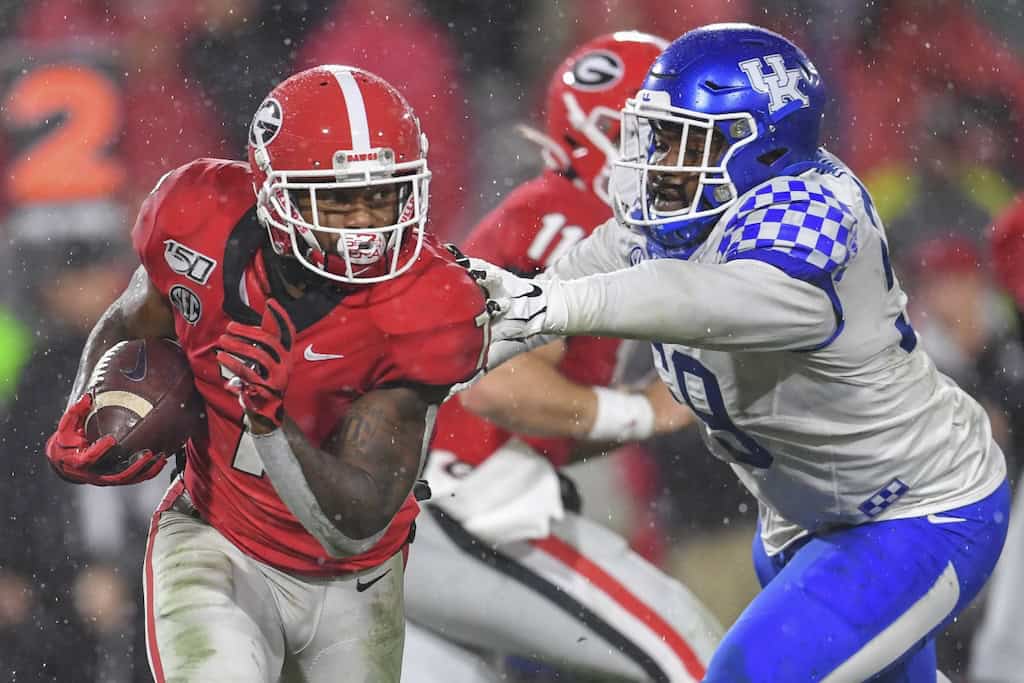
Betting on college football works like betting on the NFL: you pick a side on the spread, the moneyline or the total, or bet on a futures market such as the national title or the Heisman. What changes is the size of the board, with far more teams and far bigger gaps between them, and a 12-team playoff that runs from December 18, 2026, to the national championship at Allegiant Stadium in Las Vegas on January 25, 2027.
This guide covers each bet type with the arithmetic behind it, then the dates and markets that matter for the 2026 season. Our game-by-game reads are on the college football predictions hub.
The three main bets
A point spread is a handicap. If a team is favored by 7.5 points, it has to win by 8 or more for a bet on it to win; the underdog side wins if it loses by 7 or fewer or wins outright. Both sides are usually priced at -110, which means risking $110 to win $100 and needing to win 52.4% of the time to break even.
A moneyline is a bet on who wins, with no points involved. A -250 favorite needs to win 71.4% of the time for the price to be fair, and a +200 underdog 33.3%. College football moneylines can run much longer than that when a top team plays a weak one.
A total, or over/under, is a bet on the combined score. If the total is 52.5, the over wins at 53 points or more and the under at 52 or fewer. The half point means a total can never land exactly on the number and push.
Props, parlays and live bets
Props are bets on something inside a game: a quarterback’s passing yards, a running back’s touchdowns, which team scores first. They are priced like any other bet, so the same break-even arithmetic applies.
A parlay ties several bets into one, and every leg has to win. Three legs at -110 pay about +596, which implies 14.4%. If each leg is a fair 50-50 bet, the true chance of all three winning is 12.5%, and the gap between the two is the book’s margin, stacked three times.
Live betting prices the game as it is played. The margin on live prices is built in the same way, and a line posted during a game can move before a bet is accepted.
Futures: the national title and the Heisman
On ESPN’s futures board, read September 25, 2026, DraftKings had Ohio State as the favorite to win the national championship at +520. This is the 2026 season’s market: it prices Indiana, which won the title in January 2026, at +950, a price that could not be posted on a market already settled.
| Team | Title odds | Implied chance |
|---|---|---|
| Ohio State | +520 | 16.1% |
| Texas | +620 | 13.9% |
| Georgia | +650 | 13.3% |
| Notre Dame | +650 | 13.3% |
| Miami | +850 | 10.5% |
| Indiana | +950 | 9.5% |
The Heisman Trophy board on the same read had Trinidad Chambliss at +310 and Darian Mensah at +370, with Jeremiah Smith third at +1050. A futures bet is worth making only when you rate the chance higher than the price does, and the six title favorites alone add up to 76.7% before the other 100 teams on the board are counted.
How the 2026-27 College Football Playoff works
The field is 12 teams. Five conference champions earn automatic bids: the ACC, Big Ten, Big 12 and SEC champions, plus the highest-ranked champion from the American, Conference USA, MAC, Mountain West, Pac-12 and Sun Belt. The top four seeds get a first-round bye, according to the College Football Playoff.
| Round | Dates | Sites |
|---|---|---|
| First round | December 18 and 19, 2026 | Campuses of the higher seeds |
| Quarterfinals | December 30, 2026, and January 1, 2027 | Fiesta, Peach, Cotton and Rose bowls |
| Semifinals | January 14 and 15, 2027 | Orange and Sugar bowls |
| National championship | January 25, 2027 | Allegiant Stadium, Las Vegas |
The schedule, sites and every other bowl game are on our College Football Playoff page and bowl schedule. For the title game, see our national championship odds and our guide to betting the national championship.
Five habits that save money
Shop the line. The same game can be -110 at one book and -105 at another, and at -105 the break-even rate drops to 51.2%. Our sportsbook reviews compare the books.
Bet a fixed unit. Staking 1% to 2% of a bankroll on each bet means a losing week of 0-5 costs 5% to 10% of it. Track every bet, because a record in units at the prices taken is the only record that says whether you are winning.
Read the week before you bet it. Our Week 5 schedule and predictions lists every game with its kickoff and TV. For picks from paid handicappers, see our handicapper site reviews.