NFL Previews
  MLB Previews
  NBA Previews
  NHL Previews
  Soccer Previews
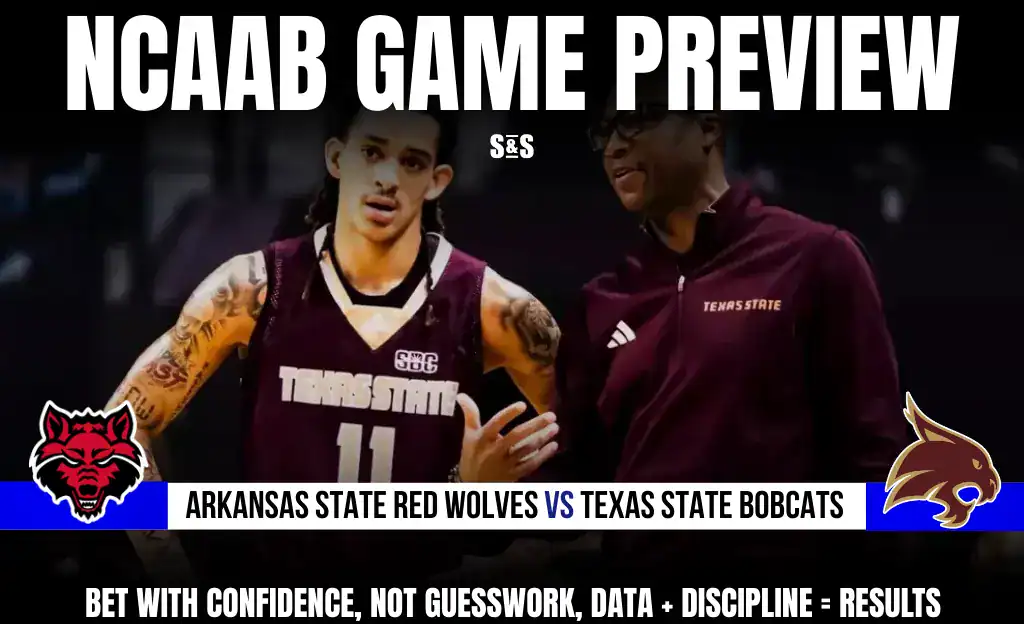

Game Preview Arkansas State Red Wolves @ Texas State Bobcats
Arkansas State travels to San Marcos to face Texas State on December 17 in a Sun Belt matchup that profiles as a tempo-versus-control game. The Red Wolves have played faster through the non-conference portion of the schedule, while the Bobcats have generally been more deliberate and defense-oriented. That contrast is often where betting value shows up in mid-major conference games, especially when the market posts a total that assumes one team’s preferred pace will dominate.
From a handicapper’s point of view, the first layer is always the market context: where the opener lands, how quickly the number moves, and whether the move appears to be driven by matchup fit or public bias. The cleanest way to track that is by monitoring the live board on NCAAB odds and scores and comparing similar Sun Belt matchups on the NCAAB picks slate.
On paper, Arkansas State’s profile is tied to pace and shot volume. Texas State is more likely to win by compressing possessions, controlling the defensive glass, and turning this into a half-court game where execution matters more than raw number of trips. That sets up a handicap where the side and total are connected: if Texas State can slow Arkansas State, it improves the underdog’s cover chances and increases the probability of an under-friendly game script.
For team-level context, it helps to keep both programs within the broader conference landscape available through the NCAAB teams directory, especially when evaluating how each team’s pace and defensive performance compare to peers.

Streamline Your Picks in One Dashboard
All Sports. All Experts. One Login.
Odds and Key Information
Most market boards list Arkansas State as a small road favorite, with spread pricing commonly in the range of Arkansas State -2.5 to -4.5 and a total around the high-140s to low-150s. The specific number matters because this matchup features a meaningful pace gap: Arkansas State has been playing at a quicker possession rate, while Texas State has shown a slower baseline. A total around 150 implies either a faster-than-usual game for the Bobcats or above-average offensive efficiency for both teams.
A practical workflow is to reference the current line and total on NCAAB odds and scores and then cross-check slate-wide context through NCAAB picks, where similar mid-major spreads often cluster by matchup type.
Key information
| Category | Notes |
|---|---|
| Matchup | Arkansas State Red Wolves @ Texas State Bobcats |
| Date | December 17 |
| Location | San Marcos, Texas |
| Market view | Arkansas State small favorite; total in the high-140s/low-150s range |
| Tracking tools | NCAAB odds and scores, NCAAB picks |
This is also a matchup where team pages can clarify stylistic tendencies in a single click. The Red Wolves’ profile is best tracked through the Arkansas State page in the NCAAB teams directory, and the same applies for Texas State’s team page within that index.
Arkansas State Outlook
Arkansas State enters this game with a profile that leans toward higher possession counts and a shot mix that includes meaningful perimeter volume. That matters against Texas State because the Bobcats’ defensive identity is built around limiting easy looks and finishing possessions with rebounds. If Arkansas State can maintain its pace without turning the ball over, the Red Wolves can create enough volume to pressure Texas State’s half-court offense.
From an efficiency standpoint, Arkansas State’s offense has been more productive than Texas State’s through the non-conference slate, but the pathway is different: Arkansas State’s edge is often generated by tempo and shot creation, while Texas State’s edge is more defensive and possession-based. In betting terms, Arkansas State can cover as a small favorite if it wins the possession battle (extra attempts via offensive rebounds, fewer turnovers) and forces Texas State to play from behind, where the Bobcats must accelerate beyond their preferred style.
The key tactical question is how Arkansas State’s perimeter usage interacts with Texas State’s defensive structure. Arkansas State has had games where its three-point rate is high enough to introduce volatility: makes can create separation quickly; misses can fuel Texas State’s preference for controlling tempo and forcing long possessions. When you evaluate Arkansas State’s game-to-game results, the most important indicators for this matchup are turnover rate and defensive rebound rate. If Arkansas State is sloppy with the ball, Texas State’s slower tempo becomes more valuable because each turnover is a high-leverage lost possession in a lower-possession environment.
In conference play, bettors often overvalue early scoring averages without adjusting for pace. Using the NCAAB odds and scores board to compare totals across similar pace profiles can help avoid that trap, and reviewing Arkansas State within the broader NCAAB teams ecosystem provides a cleaner baseline for what the Red Wolves look like relative to the conference.
Texas State Outlook
Texas State’s cover case starts with defense and the glass. The Bobcats have generally been better positioned to keep opponents from scoring efficiently, and they tend to prefer games where the opponent is forced into longer possessions rather than transition opportunities. If Texas State can get Arkansas State to operate late in the shot clock, it reduces the Red Wolves’ most valuable edge: volume through pace.
Offensively, Texas State’s challenge is consistency. In games where the Bobcats’ half-court execution is stable and they protect the ball, their defensive base often keeps them within striking distance. But when the offense becomes turnover-prone or settles into low-quality late-clock attempts, the margin can drift against them. That is why the early minutes matter for the underdog: if Texas State can avoid empty possessions early, it can keep the game inside one or two possessions and make the spread play more like a coin flip late.
Texas State also has a shot profile that is typically more two-point oriented than Arkansas State’s. That can be helpful against a team that is comfortable trading threes, because it allows Texas State to manufacture points via rim attempts and free throws rather than relying solely on perimeter variance. It can also reduce total volatility if Texas State consistently uses clock and attacks the paint. The downside is that if Arkansas State’s defense can load up on interior looks and force kick-outs late, Texas State may have fewer clean perimeter shots than it needs to keep up.
For bettors, the easiest way to anchor Texas State’s identity is to keep its team context tied to the NCAAB teams directory and then use NCAAB odds and scores to see how the market prices Texas State totals compared to other slower-tempo defensive teams.
Key Matchup
The core matchup is Arkansas State’s pace and perimeter volume versus Texas State’s ability to control possessions through defensive rebounding and half-court resistance.
If Arkansas State dictates tempo, the game can climb into a possession range where a total around 150 becomes realistic, and where a small Arkansas State spread can cover through shot volume even without elite efficiency. In that script, the Red Wolves do not need to dominate; they simply need to generate more attempts and maintain a modest efficiency edge.
If Texas State dictates tempo, the game becomes more spread-sensitive. A lower-possession game increases the value of each scoring run and makes it harder for a small favorite to separate. That is where Texas State’s defense-first identity can produce cover equity, because holding Arkansas State to a lower effective field goal rate and preventing second chances compresses the margin.
Three swing categories are especially relevant:
- Turnovers. Both teams can be turnover-prone at times, but the underdog benefits more from a clean game. If Texas State can avoid live-ball turnovers, it prevents Arkansas State from getting the easy points that inflate both pace and total scoring.
- Defensive rebounding. Texas State’s ability to finish possessions is crucial. Extra Arkansas State attempts are a direct pathway to an over and to favorite margin.
- Three-point variance. Arkansas State’s perimeter reliance can create a split outcome distribution. Strong shooting stretches can push the favorite clear; cold stretches can drag the game into a grind where Texas State’s style is more effective.
For bettors who like broader market frameworks on managing variance and timing, many of the concepts in the NBA expert betting guide translate cleanly here: pace dictates the number of possessions, possessions dictate total opportunity, and opportunity dictates how much variance the underdog can absorb.
Betting Trends
Arkansas State trend notes are often linked to pace-driven totals and streaky scoring distribution. When the Red Wolves control tempo, games can land higher than market expectation; when opponents slow them down, the scoring profile can flatten. For spread performance, Arkansas State’s results tend to track closely with turnover margin and three-point efficiency, which makes them less stable as a road favorite than a team with a more interior-oriented scoring base.
Texas State’s trends typically lean toward lower-scoring, possession-controlled games, particularly at home. The Bobcats are more likely to cover when they hold opponents below their average efficiency and force longer half-court possessions. That is the main reason totals and spreads in Texas State games often move late: the market reacts to expected tempo, and tempo can be influenced by lineup availability and the opponent’s willingness to run.
If you are comparing these patterns across the slate, it is useful to keep one tab on NCAAB odds and scores for movement and another on NCAAB picks to see how similar mid-major conference games are being priced and discussed.
For larger-picture season context that can influence how the market treats teams over time, futures content like College Basketball Championship odds helps frame which conferences and profiles are being respected broadly, while player-market content like John Wooden Award odds/predictions can provide insight into where elite usage and scoring gravity tend to cluster. Those are not matchup-specific inputs here, but they help reinforce how markets value efficiency versus volume across the sport.
Prediction
This matchup projects as a competitive Sun Belt game where the total hinges on whether Texas State can slow Arkansas State’s pace. The market giving Arkansas State a small-favorite tag is consistent with a modest efficiency edge, but the location and tempo clash make this less straightforward than a typical power-conference mismatch. Texas State’s best pathway is to turn this into a half-court game, reduce transition, and win the defensive rebounding battle. Arkansas State’s best pathway is to keep possessions high enough that its offensive volume creates separation.
Given the pace profiles, a total in the 150 range can be ambitious if Texas State controls the game state. That does not require Texas State to dominate; it only requires the Bobcats to keep the possession count closer to their baseline than Arkansas State’s. On the side, Arkansas State can still win, but a margin cover becomes more fragile in a lower-possession environment.
Projected score: Arkansas State 74, Texas State 71
Spread pick: Texas State +4.5
Total lean: Under 150.5
Bet With Confidence, Not Guesswork
Data + Discipline = Results
Why You Need Expert Picks
Mid-major conference games are one of the most efficient places for bettors to improve results through information discipline. Rotations can shift quickly, travel spots matter more, and the market can be slower to reprice tempo changes than it is in higher-profile leagues. That is exactly why building your process around consistent tools matters.
The NCAAB picks page provides matchup-by-matchup coverage and a centralized place to evaluate daily edges. It is also where you can follow the Handicappers Leaderboard, which is a practical way to separate short-term noise from long-term performance. Instead of picking games in isolation, bettors can track who is consistently identifying value, how those picks perform against closing lines, and which handicappers align with specific bet types such as sides versus totals.
Pairing that with NCAAB odds and scores gives you a live market lens. Line movement, total movement, and timing around tip-off can all reflect information that is not obvious from a box score. Using the NCAAB teams directory to ground your team-level assumptions reduces the risk of overreacting to a single recent result, which is one of the most common mistakes in mid-major handicapping.
For bettors who want a broader strategy foundation, the NBA expert betting guide provides a useful framework for thinking about variance, market timing, and bet sizing concepts that apply directly to college basketball, especially in games like this where pace and possessions are the primary drivers of both side and total outcomes.